
Maximizing Profits in Commercial Fish Farming: Advanced Strategies Beyond Species Selection
By Wisdom Ugochukwu Lambert
Agricultural Business News Reports | Gossiphome TV
In our previous article, we highlighted the Top 10 Fast-To-Grow Fish Species in the World, detailing how selecting species like African Catfish, Nile Tilapia, and Barramundi can significantly reduce cultivation cycles. However, selecting a genetically fast-growing fish is only half the battle.
Even the fastest-growing species will stall if farm infrastructure, feeding regimes, and environmental controls are poorly executed. To convert rapid biological growth into commercial success, fish farmers must master the operational levers that dictate daily weight gain and feed efficiency.
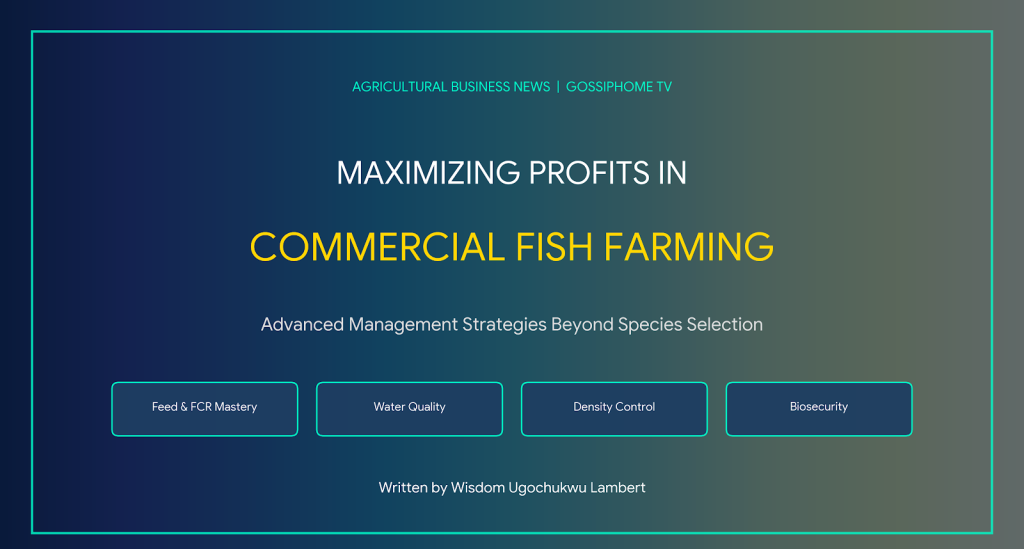
Below are four advanced management strategies every commercial fish farmer must implement to maximize profitability and shorten market turnaround.
1. Feed Optimization and FCR Mastery
Feed accounts for up to 60% to 70% of total production costs in commercial aquaculture. Achieving a fast growth rate profitably relies entirely on optimizing your Feed Conversion Ratio (FCR)—the measure of how efficiently fish convert feed mass into body weight.
-
High-Protein Pellets by Stage: Fingerlings and juveniles require feed with higher crude protein content (40%–45%), while grow-out stages require lower protein ratios (30%–35%) balanced with adequate lipids and carbohydrates.
-
Precision Feeding Schedules: Avoid both underfeeding (which causes stunted growth and cannibalism) and overfeeding (which wastes money and pollutes water quality). Implement response-based feeding schedules using floating pellets to observe appetite in real-time.
-
Feed Timing and Water Temperature: Fish metabolism is directly linked to water temperature. Feed during peak oxygen hours (typically mid-morning to late afternoon) when water temperatures are optimal for digestion.
2. Water Quality and Dissolved Oxygen Control
Water quality is the ultimate limiting factor in fish growth. Poor water quality increases stress, suppresses appetite, and leaves stock vulnerable to pathogen outbreaks.
-
Maintain High Dissolved Oxygen (DO): Fast-growing fish consume significantly more oxygen, especially after feeding. Utilizing mechanical surface aerators or paddlewheels ensures DO levels stay above 5.0 mg/L, promoting rapid metabolic processing of feed.
-
Ammonia and Nitrite Management: Accumulation of un-ionized ammonia ($NH_3$) damages fish gills and severely inhibits growth. Maintain continuous water exchange or use biofilters in Recirculating Aquaculture Systems (RAS) to convert toxic ammonia into harmless nitrates.
-
pH Stabilization: Keep water pH within the optimal range of 6.5 to 8.5. Extreme pH fluctuations cause physiological stress, halting feeding activity.
3. Density Management and Grading Protocols
Overstocking and size variation within a single pond are two silent profit killers in fish farming.
-
Routine Grading (Sorting): Fast-growing species often exhibit aggressive territorial behavior. Routinely sorting fish by size every 3 to 4 weeks prevents dominant individuals (“shooters”) from monopolizing feed and preying on smaller tankmates.
-
Optimal Stocking Densities: While high-density stocking increases biomass, exceeding the carrying capacity of your system leads to oxygen depletion and slowed individual growth rates. Match stocking density strictly to your aeration and filtration capabilities.
4. Biosecurity and Disease Prevention
A single disease outbreak can eliminate months of rapid growth in a matter of days. Proactive biosecurity protocols protect your stock investment:
-
Quarantine New Fingerlings: Always quarantine new stock from suppliers for 7 to 14 days before introducing them to existing grow-out ponds.
-
Disinfection Protocols: Disinfect equipment, nets, and boots between ponds to prevent cross-contamination.
-
Pond Drying and Preparation: Between production cycles, thoroughly drain, lime, and sun-dry earthen ponds to eradicate leftover pathogens, parasites, and wild predators.
The Bottom Line
Choosing a fast-growing species gives your business a competitive head start, but operational excellence determines your final profit margin. By pairing the right species selection with disciplined feed management, proactive water quality controls, and strict biosecurity, fish farmers can achieve maximum yield in record time.
For more exclusive agricultural insights, market updates, and farm management guides, stay connected with Agro Business News Reports on Gossiphome TV (Gossiphome.ng).





1 thought on “4 Strategies to Maximize Commercial Fish Farming Profits”