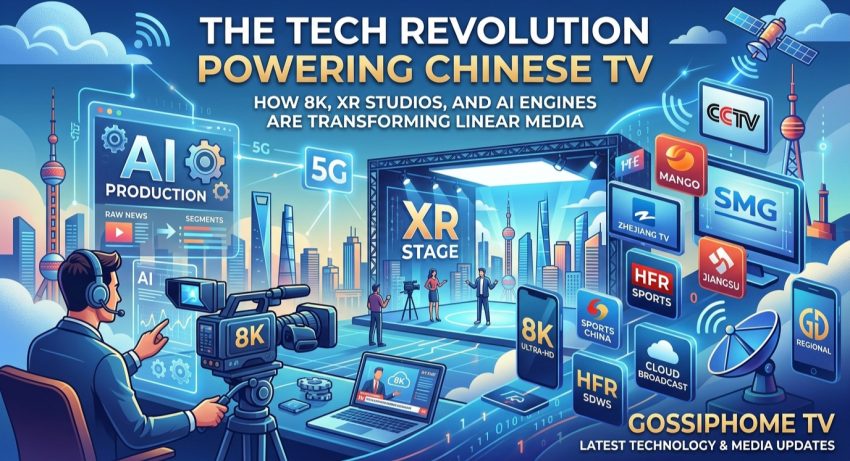
The Tech Revolution Powering Chinese TV: How 8K, XR Studios, and AI Engines Are Transforming Linear Media
While our previous breakdown highlighted the Top 10 Television Channels in China based on popularity and audience reach, the real story lies beneath the surface: the hardware, software, and cloud infrastructure driving these networks forward.
Chinese television networks are no longer relying solely on traditional cable signals. They have turned linear broadcasting into a high-tech sandbox, pioneering scale infrastructure in ultra-high-definition delivery, extended reality production, and media-focused artificial intelligence.
1. The Push to Native 8K and Ultra-HD Broadcasting
Where many international networks treat 4K as a high-end luxury and 8K as an experimental trial, China Media Group (CMG) has integrated 8K UHD directly into public service broadcasting.
-
State-Wide 8K Deployment: Channels like CCTV-1 and CCTV-5 routinely capture and distribute live flagship programming—including major athletic events and national galas—in native 8K HDR formats.
-
High-Frame-Rate (HFR) Feeds: CCTV-5 utilizes HFR 8K feeds to drastically reduce motion blur during fast-paced sports events.
-
Decentralized 8K Public Displays: Beyond living rooms, 8K signals are delivered directly to massive urban outdoor LED displays across major metropolitan transit hubs and public squares, creating immersive shared viewing experiences.
2. Extended Reality (XR) and Virtual Production Stages
Physical studio sets are rapidly becoming secondary for major provincial satellite stations. Stations like Jiangsu TV and Zhejiang TV lead the industry in real-time extended reality (XR) and augmented reality (AR) visual rendering.
-
Real-Time LED Volumes: Production crews use ultra-dense LED walls synchronized with real-time camera tracking systems (powered by engines like Unreal Engine), replacing green screens completely.
-
Photorealistic Stage Design: During live music competitions and seasonal galas, Jiangsu TV deploys XR stages where visual environments change dynamically around performers in real time with zero latency.
-
Spatial Audio Integration: These visual environments are coupled with multi-channel spatial audio, ensuring home surround-sound systems mirror the acoustic acoustics of virtual visual spaces.
3. AI Engines in Modern Newsrooms
News automation has moved from basic teleprompters to dynamic AI-assisted production toolchains. Regional and national hubs like Dragon TV (SMG) and CCTV-1 have adopted proprietary AI models built specifically for video workflows.
-
Automated Archival Tagging: AI models index decades of video archives in real time, auto-tagging footage based on facial recognition, location detection, and speech recognition to reduce video editing times during live news breaks.
-
Text-to-Video Visualizations: Editorial teams utilize text-to-video tools to quickly draft visual background mockups and graphical explainers for complex economic or technical news reports.
-
Synthetic Presenters & Local Translation: State and regional networks deploy hyper-realistic digital avatars for supplementary news bulletins and multi-language international broadcasts, ensuring continuous coverage without full studio crews.
ALSO CHECK: How to Buy on 1688.com Using a Purchasing Agent: Step-by-Step Guide
4. Convergence Architecture: The Hybrid Cloud Strategy
The division between linear satellite broadcasting and OTT streaming apps has virtually vanished. Broadcasters now treat linear TV channels as one endpoint of a multi-screen cloud strategy.
-
Hunan TV & Mango TV Ecosystem: Hunan TV operates in a tight loop with Mango TV. Live satellite feeds stream simultaneously alongside interactive mobile overlays, letting viewers participate in live polls, access multi-cam feeds, and purchase featured products via TV-commerce integrations.
-
5G + Cloud Remote Production: Outside broadcast (OB) trucks rely heavily on bonded 5G multi-network transmission. Rather than hauling massive mobile editing suites to location shoots, raw multi-camera feeds are ingested directly to cloud newsrooms, where editors assemble packages remotely in real time.
Key Technology Stack Across Leading Chinese Networks
| Technology Domain | Primary Broadcasters | Technical Application |
| 8K Ultra-HD Capture | CCTV-1, CCTV-5 | Native 8K live sport/gala broadcasts, HFR feeds, outdoor LED distribution. |
| XR / AR Production | Jiangsu TV, Zhejiang TV | Real-time virtual studio stages, LED wall integration, spatial audio spatialization. |
| AI News Production | Dragon TV, CCTV News | Automated asset tagging, text-to-video explainers, digital avatar anchors. |
| Cloud / 5G Delivery | Hunan TV (Mango TV), Shenzhen TV | Low-latency multi-angle mobile streams, remote cloud video editing. |
The Horizon: What’s Next?
As television screens shift from standalone displays to interactive smart home command centers, Chinese broadcasting networks are positioned at the forefront. By combining high-bandwidth 8K infrastructure, AI-enhanced editorial tools, and immersive virtual production, networks like CCTV, Hunan TV, and Dragon TV are writing the blueprint for the next decade of media consumption.
For more deep dives into the technologies shaping global broadcasting and home media, keep following Gossiphome TV!
To see an official overview of China Media Group’s Ultra-HD broadcast initiatives, check out China Media Group launches 8K-UHD public service platform. This video provides context on how national infrastructure supports ultra-high-definition television distribution across China.