
How to Successfully Partner with Chinese Electronic Sourcing Agencies: The Ultimate Blueprint
By Gossiphome TV — Your Hub for the Latest Technology Updates
In our previous article, “Top 10 Biggest Electronic Source Agencies in China,” we explored the leading agencies facilitating global hardware trade. However, selecting an agency is only the first step. Navigating cross-border communication, component verification, and quality enforcement requires a clear, structured operational playbook.
In this follow-up guide, Gossiphome TV provides an actionable blueprint for hardware developers, tech startups, and enterprise procurement teams on how to manage partners, mitigate procurement risks, and build an efficient electronic component pipeline in China.
4 Essential Stages of Working with an Electronic Sourcing Agency
Partnering with a sourcing agent involves more than handing over a product spec sheet. To protect your intellectual property and guarantee component authenticity, follow this multi-stage workflow:
Stage 1: Initial Vetting & Non-Disclosure Agreements (NDAs)
Before sharing sensitive designs, schematics, or Gerber files, secure your Intellectual Property (IP):
-
NNN Agreements: Sign a Chinese-enforceable Non-Disclosure, Non-Use, Non-Circumvention (NNN) agreement rather than a standard Western NDA.
-
Agency Credentials: Verify the agency’s business license, physical office presence (e.g., Shenzhen, Yiwu, or Shanghai), and past hardware portfolio.
Stage 2: Bill of Materials (BOM) Scrubbing & Costing
Your sourcing agent should optimize your BOM before ordering production units:
-
Lifecycle Analysis: Identify active vs. End-of-Life (EOL) or obsolete integrated circuits (ICs).
-
Second-Sourcing: Require the agent to identify equivalent, drop-in replacement components (passive and active) to prevent single-point-of-failure delays.
-
Target Costing: Establish clear unit target costs and minimum order quantities (MOQs) upfront.
ALSO CHECK: How to Source Electronics Direct from China’s Tech Malls: A Guide by Gossiphome TV
Stage 3: Factory Audits & Sample Prototyping
Never move directly into mass production without physical proofing:
-
On-Site Audits: Ensure your agency performs an ISO 9001 / ISO 13485 audit on the subcontracted PCBA (Printed Circuit Board Assembly) factory.
-
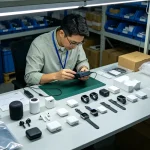
First-Article Inspection (FAI): Secure 5 to 10 golden sample units for functional bench testing, thermal stress evaluation, and firmware flashing before approving full production runs.
Stage 4: Quality Assurance & Anti-Counterfeit Verification
Counterfeit and refurbished chips pose significant risks in the electronics market. Require your sourcing partner to execute a strict incoming inspection protocol:
[ Incoming Batch ] ──► [ Visual Inspection ] ──► [ X-Ray / Decap Test ] ──► [ Functional Testing ] ──► [ Shipping Approval ]
-
Visual & Marking Inspection: Check for re-marked, re-sanded, or recycled pins.
-
X-Ray & Decap Analysis: Verify internal die authenticity for high-value microcontrollers and specialized processors.
-
Functional Testing: Flashing test software on 100% of finished assemblies to confirm operational stability.
Red Flags to Watch Out For When Sourcing Components
| Risk Factor | Common Indicator | Mitigation Strategy |
| Unrealistically Low Pricing | Component quoted at 40%+ below global market rate | Request full batch traceability & original factory certificates (CoC). |
| Lack of Transparency | Agency refuses to disclose manufacturing locations | Require factory name, address, and audit report as contract terms. |
| Vague Quality Guarantees | Promises of “100% quality” without defined defect limits | Establish strict Acceptable Quality Limits (AQL Level II, 1.0/2.5). |
| Payment Pressure | Demands for 100% upfront wire transfers | Stick to standard terms: 30% deposit, 70% balance upon inspection approval. |
MORE ARTICLE: Top 10 Biggest Digital & Electronics Malls in China
Strategic Checklist for Tech Procurement Teams
To ensure a smooth procurement cycle with your chosen agency, run through this final checklist prior to placing mass production purchase orders:
-
[ ] Signed Chinese-enforceable NNN Agreement on file.
-
[ ] BOM scrubbed for EOL components and alternative parts approved by lead engineer.
-
[ ] Golden sample approved and signed by both parties.
-
[ ] Acceptable Quality Limit (AQL) standards defined in the contract.
-
[ ] Escrow or milestone-based payment structure finalized.
Key Takeaways from Gossiphome TV
A successful partnership with a Chinese electronic sourcing agency relies on clear technical specifications, strict quality control protocols, and formal legal frameworks. By treating your sourcing agency as an extension of your engineering team, you can mitigate component risks and launch reliable technology products on time.
Stay tuned to Gossiphome TV for more tech insights, hardware analysis, and global supply chain updates!




1 thought on “How to Partner with Chinese Electronic Sourcing Agencies: A Step-by-Step Guide”