
After the Reveal: The Engineering & Regulatory Reality of Elon Musk’s Flying Tesla
By Gossiphome TV Tech Team
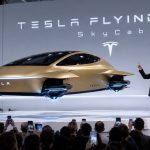
The initial shockwave of Elon Musk’s live demonstration in Waco, Texas—where a cold-gas thruster-equipped Tesla Roadster executed mid-air hops and dynamic maneuvers—has begun to settle. Beyond the viral spectacle, automotive engineers, aviation authorities, and prospective buyers are asking a critical question: What actually happens next?
While the demonstration proved that high-pressure cold-gas thrust can briefly overcome gravity for a passenger vehicle, transitioning a prototype into a production vehicle compliant with federal safety standards presents unprecedented challenges.
1. The Physics and Practical Limits of Cold-Gas Propulsion
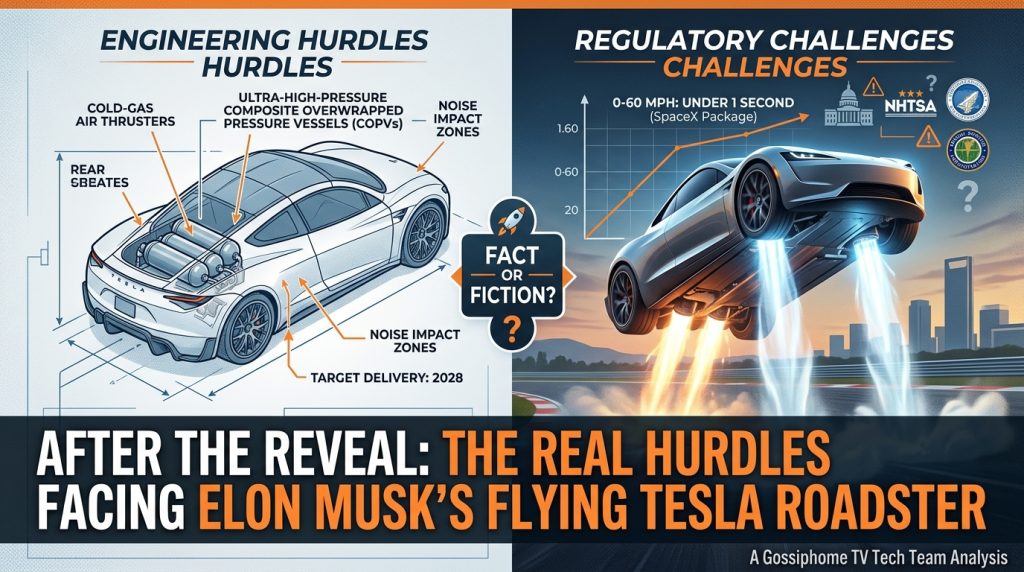
The technology behind the Roadster’s flight capabilities relies on SpaceX-derived cold-gas thrusters—compressed air stored in ultra-high-pressure composite overwrapped pressure vessels (COPVs) placed where the rear seats normally sit.
-
Energy Density vs. Flight Duration: Cold-gas systems deliver massive instantaneous thrust without thermal combustion, making them safe for vehicle integration. However, unlike continuous electric rotors, compressed air exhausts rapidly. The thrusters provide short burst assistance—ideal for rapid acceleration, jumping obstacles, or short hops—rather than sustained cruise flight.
-
Noise and Acoustic Impact: Discharging compressed air at high pressures generates high-decibel noise blasts. Operating these thrusters in urban settings or suburban neighborhoods faces immediate noise ordinance barriers.
-
Refill Mechanics: Once expended, the composite air tanks must be recharged using aboard high-efficiency compressors, requiring dedicated battery power and time between uses.
2. Regulatory Stumbling Blocks: DOT vs. FAA
The biggest hurdle standing between the Roadster and consumer driveways isn’t software—it’s regulatory classification.
+--------------------------------------------------------------------+
|                   DUAL REGULATORY JURISDICTION                     |
+--------------------------------------------------------------------+
|                                                                    |
|    NATIONAL HIGHWAY TRAFFIC SAFETY      FEDERAL AVIATION           |
|         ADMINISTRATION (NHTSA)          ADMINISTRATION (FAA)       |
|    -------------------------------      --------------------       |
|    • Crashworthiness & Airbags          • Airworthiness Certification|
|    • Pedestrian Impact Standards        • Controlled Airspace Access|
|    • Pressure Vessel Road Safety        • Pilot/Operator Licensing |
|                                                                    |
+--------------------------------------------------------------------+
The U.S. Department of Transportation (DOT) and the Federal Aviation Administration (FAA) operate under completely distinct frameworks. While startup rival Alef Aeronautics secured a Special Airworthiness Certificate from the FAA for its low-speed, rotor-based Model A, Tesla’s cold-gas thruster design falls into an unprecedented category.
Tesla’s official site explicitly clarifies that the experimental flight features are currently restricted from general road use. Deliveries starting in the 2028 target window will likely include software locks that geofence thruster activation exclusively to private racetracks and designated closed courses.
3. Market Reactions & Competitor Responses
The demonstration sparked immediate reactions across the automotive and eVTOL sectors:
| Parameter | Tesla Roadster (SpaceX Package) | Alef Model A |
| Flight Mechanism | Cold-Gas Thrusters (Short Burst) | Internal Multi-Rotor (Continuous eVTOL) |
| 0–60 mph Acceleration | Under 1.0 second | Standard Electric Drive |
| Regulatory Status | Track / Experimental Only | FAA Special Airworthiness |
| Target Delivery | 2028 | 2026–2027 |
| Est. | ||
Industry observers note that while Alef focuses on low-speed street driving combined with sustained point-to-point vertical flight, Tesla’s approach prioritizes extreme supercar performance enhanced by aerospace hardware.
Summary
Elon Musk’s flying Roadster demonstration delivered on visual impact, but the path from prototype to street-legal vehicle remains a multi-year effort. As 2028 approaches, the focus will shift from high-flying stunts to ground-level engineering, manufacturing scalability, and navigating federal safety clearance.